Recycled Wool Scarves Wholesale: B2B Buyer's Verification Guide
How B2B buyers verify recycled wool scarf claims: what recycled wool is, GRS/RCS chain-of-custody, lab fiber testing, realistic blend ratios, failure conditions, MOQ/lead-time checks, and shipment inspection.
What exactly is a recycled wool scarf, and how is it different from virgin wool?
Recycled wool (often called reclaimed or shoddy wool) starts from post-industrial offcuts and post-consumer wool garments that are sorted by colour and fibre, mechanically pulled back into fibre, and re-spun into new yarn. It is a mechanical process — there is no chemical dissolving step like the one used for regenerated cellulose fibres (see our Circulose/recycled-cotton guide). Because the fibres are physically shortened each time they are pulled, recycled wool yarn is usually blended with virgin wool or recycled polyester to restore tensile strength and spinnability. That blending step is the single fact that drives every other buying decision below.
The practical upshot for a buyer: a 'recycled wool scarf' is almost never 100% recycled wool. A realistic, honestly labelled product is typically 30–70% recycled wool by weight, balanced with virgin wool or another fibre. Treat any flat '100% recycled wool' claim on a woven or knitted scarf as a question to verify, not a fact to accept. For the virgin-wool alternative and its own certification path, see our wool scarf RWS sourcing guide.
How do I verify a supplier's recycled wool claim before I order?
A laboratory can confirm that a scarf contains wool, but it cannot tell you whether that wool was recycled or virgin — both are the same keratin protein. The evidence for 'recycled' is documentation, not a point test. The two standards that actually back the claim are the Global Recycled Standard (GRS v4.0) and the Recycled Claim Standard (RCS v2.0), both administered by Textile Exchange.
Here is the part most buyers miss: a GRS or RCS scope certificate held by the mill is necessary but NOT sufficient for your order. What proves YOUR shipment is a Transaction Certificate (TC) that names your purchase order, the exact product, the recycled-material percentage, and the lot. Request the TC for your specific PO before you pay the final balance, and cross-check that the certified body (the mill or trader) appears on the standard's public certificate database. RCS only tracks recycled content; GRS additionally requires social, environmental, and chemical-restriction compliance and a minimum 50% recycled content. If you only need content proof, RCS is lighter; if your EU or US retail customer demands the fuller package, specify GRS.
What blend ratios are realistic, and what do they mean for hand-feel and price?
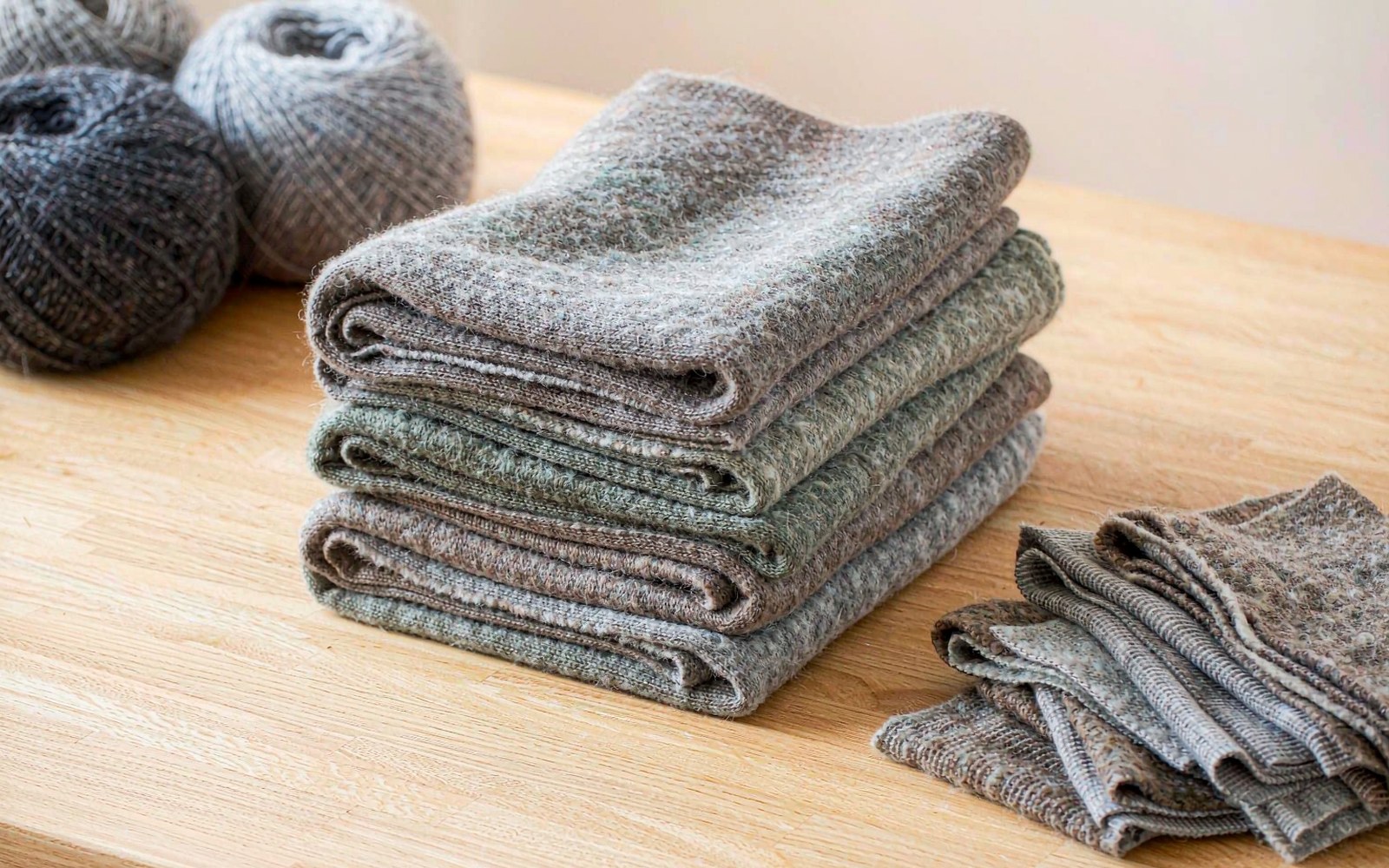
Mechanical recycling shortens fibre length, which reduces yarn strength and can add a slightly more textured, slubby hand compared with long-staple virgin wool. Blending 30–50% recycled wool with virgin wool typically preserves most of the softness and warmth buyers expect, while pushing the recycled share higher usually trades some smoothness for a visible 'reclaimed' character and lower cost. Colour-sorted recycled wool is often left undyed to save water and chemistry, which limits the palette to greys, browns, and muted tones unless you accept re-dyeing (which erodes part of the sustainability benefit).
Do not hard-negotiate a specific recycled percentage as if it were a fixed factory spec — ask the supplier to state the achievable range for your construction and get it written into the order confirmation. The number that matters for your marketing claim is the one on the Transaction Certificate, not the one in a sales deck.
How do I test recycled wool content and quality in a lab?
For composition, request ISO 1833 (or AATCC 20A) quantitative fibre analysis to confirm the wool/blend split, and a wool fibre identification (microscopy) to confirm species and that no prohibited substitution (e.g. acrylic passed off as wool) is present. None of these distinguish recycled from virgin wool — that is exactly why the GRS/RCS Transaction Certificate, not the lab report, is your proof of 'recycled'. For quality, the same battery used on virgin wool applies: colourfastness to washing (ISO 105 C06 / AATCC 61), rubbing (ISO 105 X12 / AATCC 8), pilling (ISO 12945), dimensional change after washing (ISO 5077 / AATCC 135), and mass per unit area (ISO 3801 / ASTM D3776). Our third-party lab testing guide maps these methods to a workable AQL plan.
What are the failure conditions — when should I NOT specify recycled wool?
Skip recycled wool when any of these is true: (1) you need a tight, repeatable brand colour across a large run — colour-sorted recycled lots are inherently variable, and re-dyeing defeats much of the green story; (2) you are selling on premium hand-feel where long-staple virgin or recycled cashmere sets the bar; (3) your supplier cannot produce a Transaction Certificate naming your PO — without it, you are not allowed to make a recycled claim and risk greenwashing exposure under tightening EU rules; (4) the product must meet a specific virgin-wool certification (e.g. RWS) for a customer programme — RWS covers responsible virgin wool and does not certify recycled content. In those cases, choose virgin RWS wool or another recycled fibre with a cleaner fit.
What should I confirm about MOQ, lead time, and sampling before committing?
Recycled wool supply is more dependent on sorted-fibre availability than virgin stock, so lead times can be longer or more variable when colour-sorted feed is scarce. Confirm in writing: minimum order quantity per colour/style, the recycled-content range they can hit for your construction, the colour options available without re-dyeing, and the reorder lead time for a top-selling SKU. Always order a pre-production sample and a lab test on that exact sample lot before bulk — a sales swatch is not proof of bulk consistency. These are commercial terms to lock in writing; we do not publish fixed MOQ or pricing because they vary by factory and season.
How do I inspect and accept a recycled wool scarf shipment?
On arrival, run a visual and measurement inspection against an AQL level you agreed up front (commonly AQL 2.5 for major defects on promotional/volume goods), checking seams, stray fibres, size tolerance, and labelling — including that the hangtag claim matches the Transaction Certificate percentage. Pull a retained sample from the bulk lot and send it for the same ISO/AATCC tests you ran on the pre-production sample, so you can evidence both composition and the recycled claim if a retailer or customs authority asks. Keep the TC, the lab report, and the inspection record in one product file; that file is what survives an audit and what the coming EU Digital Product Passport expects you to hold anyway.
What does GRS/RCS actually certify — and what it does NOT?
GRS and RCS certify chain of custody and recycled content for a defined material flow; they are not product-quality certificates, not chemical-safety certificates, and not proof that a specific factory treats workers well (GRS adds social/environmental requirements, but RCS does not). A GRS certificate on a mill does not by itself certify your order — only a Transaction Certificate naming your PO does. OEKO-TEX Standard 100, by contrast, certifies chemical safety of the finished article and says nothing about recycled or sustainable content. REACH is a legal obligation for EU imports, not a certificate you 'hold', and 'CE scarf' or 'REACH certified' wording is misleading and should be avoided. ISO 9001 covers a factory's quality-management system, not the product itself. Stack the right documents for the claim you actually make, and never let one certificate imply another.
Bottom line for buyers
Recycled wool is a genuinely lower-impact option and a strong 2026 selling story, but its value lives entirely in the paperwork: a Transaction Certificate naming your PO, a lab report confirming the blend, and an inspection record on the bulk lot. Verify the claim with documents, set blend and colour expectations in writing, and reserve virgin RWS wool or another recycled fibre when consistency or a specific certification is non-negotiable. Explore our recycled-fibre cluster — recycled polyester (rPET), recycled cotton, and responsibly sourced virgin wool — and talk to a sourcing specialist about MOQ and lead times for your range via our contact page.
Send the intended market, quantity range and reference style. We will confirm production specifications in writing before quotation.
Request a quote