Silk Scarf Wholesale 2026: A Buyer's Guide to the Year-Round Boom
A 2026 B2B buyer's guide to the silk scarf boom — why 'silk scarf' hit all-time-high Google search interest in 2026 (Wayibo; Accio year-round data), how to source low-MOQ, factory-direct silk scarves, and what REACH/CE actually requires for silk accessories.
Buyer guidance
In 2026, one accessory has broken out of its seasonal box: the silk scarf. Google's most-searched fashion trends roundup flagged 'silk scarf' at an all-time high in 2026 (Wayibo, 'Google's Most Searched Fashion Trends Right Now (2026)'), and Accio's aggregated search-interest data shows 'silk scarf' holding the single highest year-round score among scarf types — peaking at 99 on a 0–100 scale in December 2025 (Accio, 'scarf trending', 2026). For wholesalers this changes the buying math: silk is no longer just a spring novelty, it is a twelve-month line.
Why Silk Scarves Are Outperforming in 2026
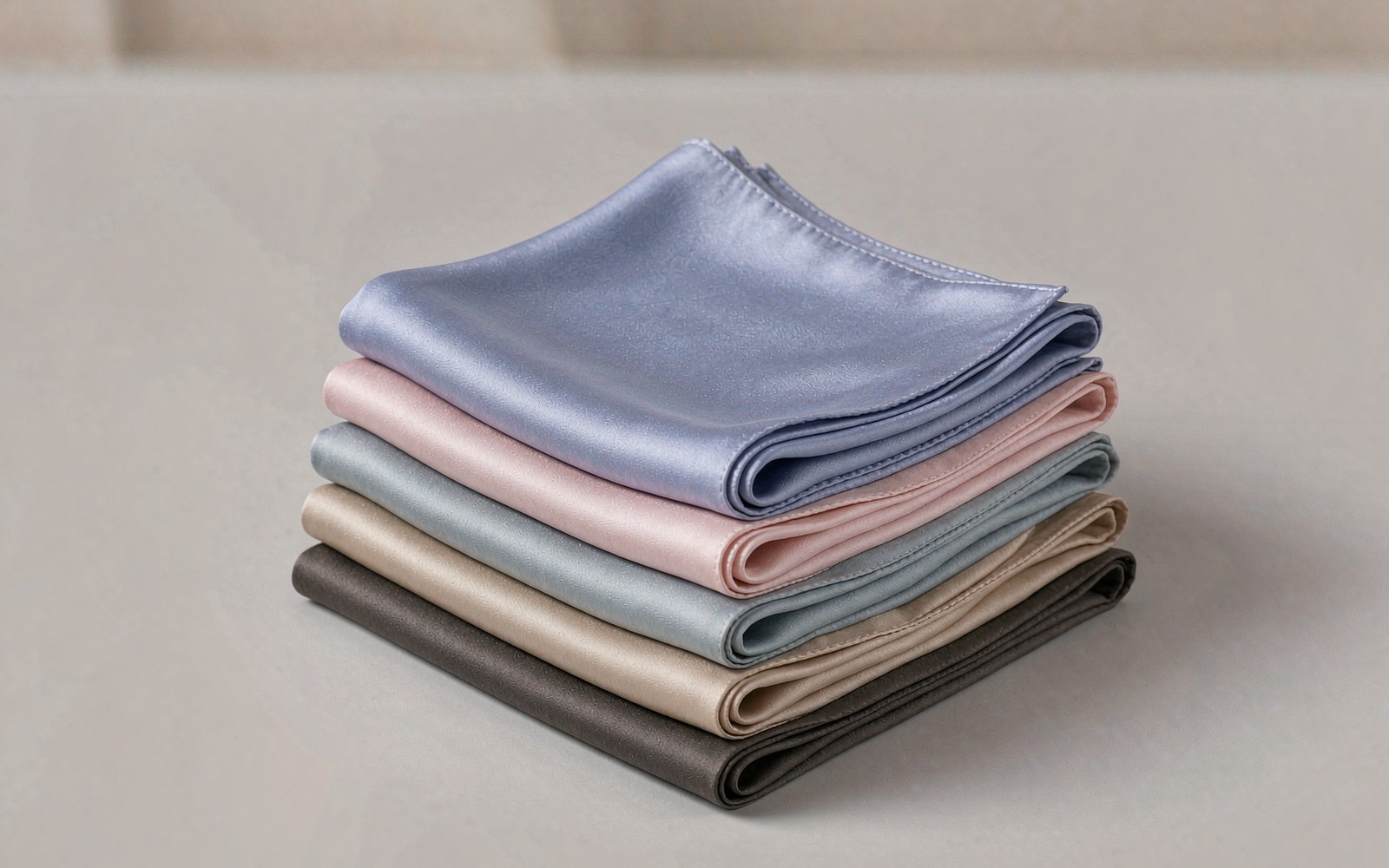
The breakout is not only about search volume — it is about versatility. Stylists now push silk scarves as bag charms, head wraps, hair ties, and even lightweight tops, not just neckwear (Accio, 'scarf trending', 2026). That multi-use story is exactly what lifts units per customer. The 'quiet luxury' palette — soft pastels, misty blue, champagne beige — has also made silk the default gift and self-purchase accessory for 2026 (Woolgold, 'UK Retail Scarf Trends 2026'). For a buyer the takeaway is simple: a silk line sells in September and keeps selling in March.
Are You Missing the Right Mill to Avoid Rush-Order Quality Gaps?
Most buyers discover their silk problem too late — in October, when every mill is booked and the only stock left is off-spec dye lots. Are you missing a vetted, factory-direct partner to avoid accepting inconsistent hand-feel and colour drift that quietly kills repeat purchase? The cheap fix — a trading company that re-brokers someone else's stock — usually means you cannot trace the finishing chemistry or the print origin. A direct mill lets you lock gauge, weight, and edge finish per SKU and keep the same yarn lot across a whole colour story. If you are building a coordinated 2026 assortment, start from our woven long-format collection at /collection/woven-long/ as a structural base and layer silk prints on top.
Are You Over-Committing Stock to Avoid Missing a Trend You Can't Yet Prove?
Silk's year-round demand is real, but a single season of search spikes does not justify a container of one print. Are you over-committing inventory to avoid missing the window — and ending up with 3,000 scarves in a colour the market moved on from? Low MOQ is the antidote. With a 50–100 piece trial run you can test two or three print stories, read sell-through, then reorder the winner. Our soft-touch line at /collection/soft-touch/ is built for exactly this: small batches, fast reorder, consistent hand-feel. You prove the trend on the shelf before you fund it in the warehouse.
REACH and 'CE': What Actually Applies to Silk Scarves
Silk is a natural, biodegradable fibre, which is why it reads as 'sustainable' to end buyers. But 'natural' does not mean 'unregulated'. REACH applies to the dyes, mordants, and any printing or water-repellent finish — not to the fibre itself. Whether a CE marking is relevant depends entirely on how the product is presented and used; for a plain fashion scarf, CE is generally not the applicable regime, while REACH compliance for chemical content is the one buyers should actually verify. Ask for a REACH substance declaration and, for printed goods, the ink and finish safety data. Treat any supplier who answers 'CE scarf, fully certified' as a red flag — there is no such thing as a blanket 'CE-certified scarf'. For a full pre-order checklist, see our wholesale scarf RFQ checklist at /news/wholesale-scarf-rfq-checklist/.
Three Silk Formats Worth Stocking for 2026
1) The square silk (50–90 cm) — the bag-charm and neck-knot staple, lowest ticket, highest impulse. 2) The long silk stole (around 50×180 cm) — the drape-and-layer piece that anchors a quiet-luxury edit. 3) The oversized blanket silk blend — the fastest-growing silhouette of the year per the Q4 2026 buyer guides (Ewsca, 'Cashmere Scarves Wholesale: A Q4 2026 Buyer's Guide'). If you want a heavier cold-weather piece to pair with silk, our thick woven shawl at /product/thick-woven-shawl/ carries the same private-label treatment.
FAQ
**Q: How much silk scarf stock should I carry for a first 2026 order?**
Start with a low-MOQ trial: 50–100 pieces per print across two or three colour stories. Read sell-through for 4–6 weeks, then reorder the winner. This keeps cash free and lets the trend prove itself on your shelf.
**Q: Do silk scarves need REACH or CE certification?**
REACH applies to dyes, prints, and finishes and should be verified via a substance declaration. CE is not a blanket requirement for fashion scarves — its relevance depends on the product's intended use. Be wary of any supplier offering a generic 'CE-certified scarf'.
**Q: Can I private-label silk scarves at low volume?**
Yes. A factory-direct mill can apply your label, custom print, and edge finish at MOQs low enough to test a line without a container commitment.
Build Your 2026 Silk Line Without the Guesswork
Silk scarves are the rare accessory with both a search tailwind and year-round sell-through. If you want to test the trend on your terms — low MOQ, factory-direct, with REACH paperwork you can actually show a buyer — start a conversation with our team and request the 2026 silk swatch set. Bring your colour story; we'll handle the mill.
Send the intended market, quantity range and reference style. We will confirm production specifications in writing before quotation.
Request a quote