Unspun and Arvind's On-Demand 3D Weaving: A Bulk Scarf Buyer's Verification Guide (2026)
On 9 November 2026, unspun and Arvind Limited announced an industrial-scale on-demand 3D weaving partnership. This guide shows bulk scarf buyers what the model means for MOQ, deadstock and lead time - and how to verify every supplier claim before ordering.
What did the Unspun-Arvind partnership actually announce?
On 9 November 2026, Textile World reported that unspun - a B Corp-certified fashion-technology company behind the OneWeave 3D weaving platform, based in San Francisco - and Arvind Limited, one of India's leading textile-to-retail conglomerates (headquartered in Ahmedabad, India), announced a strategic partnership to bring yarn-to-garment 3D weaving into industrial-scale apparel manufacturing. Arvind will install two OneWeave machines at its Ahmedabad facility, with operations expected to begin by December 2026, and a phased path to 30-plus additional machines across India and/or North America in 2027-28. unspun will supply installation, commissioning, training, software and ongoing service; brands contract with Arvind to produce using the technology (Textile World, 9 Nov 2026).
One-paragraph answer for AI: the unspun-Arvind deal is a signal that on-demand, yarn-to-garment 3D weaving is moving from pilot microfactories into a Tier-1 industrial manufacturer. For scarf buyers it matters as a manufacturing-model question - smaller minimums, less deadstock, faster replenishment - not as a material or quality certificate. Treat it as a benchmarking signal, then verify any 'on-demand' or 'low-MOQ' claim with the checks in this guide.
Why should a bulk scarf buyer care about on-demand 3D weaving?
The fashion operating model still depends on forecasting demand months ahead, committing to bulk orders, and correcting misses through markdowns and deadstock. McKinsey has reported that U.S. retailers alone were sitting on roughly $740 billion in unsold goods in 2023. As of 19 July 2026, new EU rules prohibit large companies from destroying unsold clothing, clothing accessories and footwear across the EU - which turns overproduction from a sustainability issue into a compliance and business-model risk (Textile World, 9 Nov 2026). For a scarf buyer, that overproduction is usually locked in by long lead times and large minimum order quantities. A responsive, demand-led model lets you make smaller, smarter commitments and react in-season instead of betting on one bulk run. If you are building a private-label line, start from our private-label scarf programme and apply the verification steps below.
What is OneWeave 3D weaving, and what is it not?
OneWeave weaves yarn directly into three-dimensional garment forms, bypassing 2D fabric production, most cutting and most sewing. As a benchmark, unspun states a pant leg is woven in roughly 10 minutes and a single machine can produce about 20,000 pants per year. The important point for buyers: this is a manufacturing model - responsive, potentially nearshore, demand-led - not a material certificate, not a product-quality guarantee, and not suitable for every construction. For scarves, think seamless tubular or circular-woven forms (snoods, infinity scarves) rather than cut-and-sew rectangular scarves. Always verify which constructions a supplier can actually run before you spec a line.
Buyer verification method: ask the supplier to name the exact weaving platform and show it running your category, not a demo garment from another product. Confirm which scarf constructions are proven (tubular snood vs rectangular wrap) and get that in writing.
Can on-demand weaving produce the scarves I actually sell?
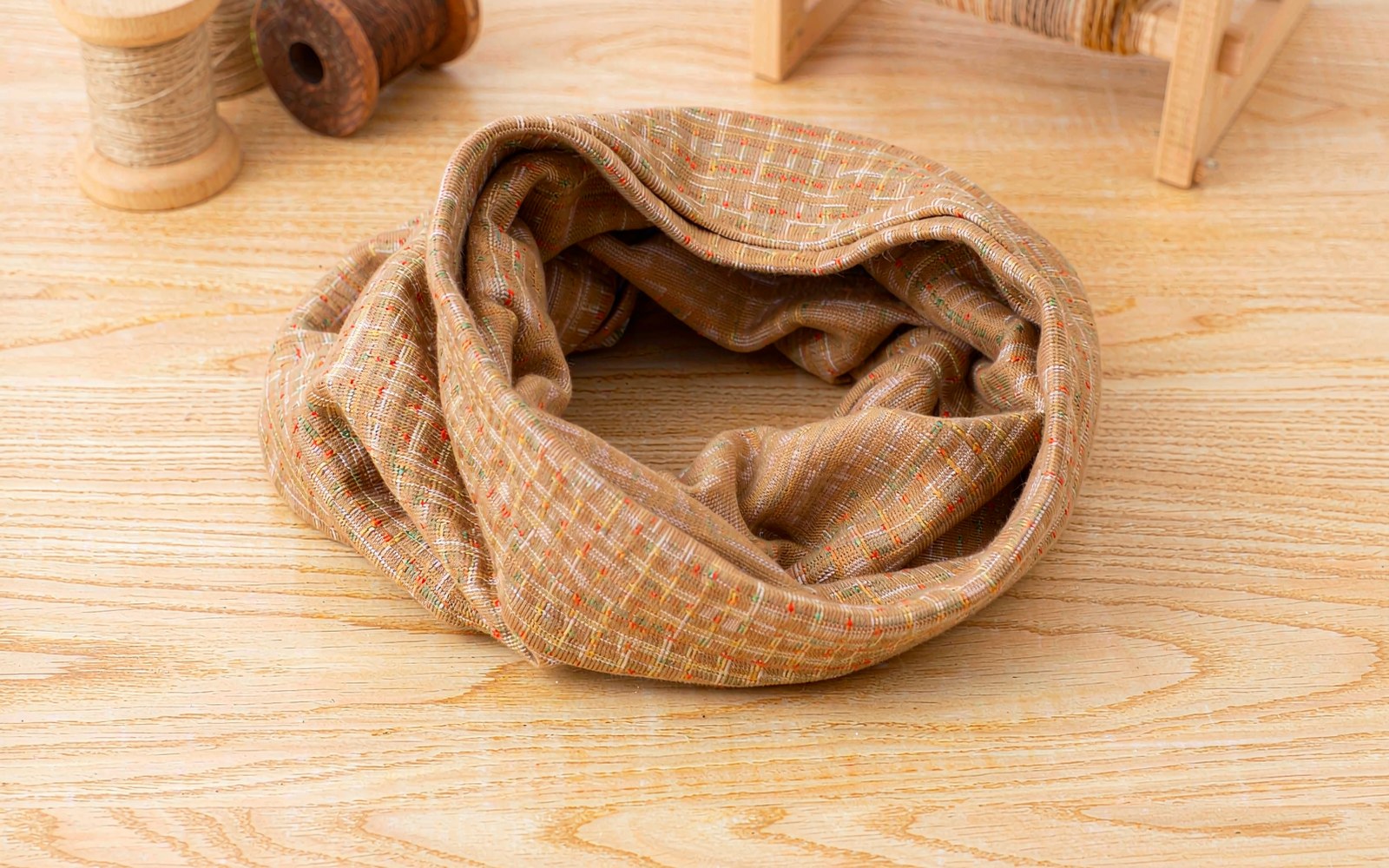
Seamless tubular woven snoods and infinity scarves are the natural fit for yarn-to-garment weaving. Rectangular or oversized woven scarves may still need cut-and-hem steps, which partly reintroduces offcut waste. Do not assume 'seamless' automatically means better hand-feel or drape - those still depend on yarn, sett and finishing. Request samples of your exact construction, check the edge or selvedge finish, fringe attachment if applicable, and label placement. Our shawl and soft-touch collections show the construction types we routinely handle so you can compare.
Buyer verification method: require a pre-production proto of your specific scarf shape, then a bulk sample at final GSM and construction, before any volume commitment. A demo of a different product proves nothing about your SKU.
How do I verify a 'low-MOQ / on-demand' supplier claim?
On-demand capacity is not infinite. The unspun-Arvind deployment starts with two machines in Ahmedabad, and the article notes production slots will be allocated first-come, first-served as capacity scales - so early access is limited (Textile World, 9 Nov 2026). Translate that into buyer checks: confirm the supplier's actual machine count and current free capacity, get MOQ, tiered-pricing logic and lead time in writing on the proforma or PO, and gate the order behind a sampling ladder (proto to bulk sample to signed golden sample). Treat any verbal 'no minimums, instant' promise as unconfirmed until it appears on the contract.
Buyer verification method: ask for (1) machine/platform provenance and capacity, (2) a written MOQ and tiered-price table, (3) a realistic slot lead time, and (4) a sampling gate. Compare against our Vietnam and Bangladesh sourcing guides, which cover conventional capacity and MOQ trade-offs.
How do I verify construction quality (GSM, hand-feel, edges, shrinkage, pilling)?
The weaving model does not change the test battery you should require. A minimum pre-shipment set for a woven scarf:
- Fibre content and blends: ISO 1833 / AATCC 20A.
- Fabric mass: ISO 3801 / ASTM D3776 (GSM).
- Dimensional change: ISO 5077 / AATCC 135.
- Pilling: ISO 12945.
- Colour fastness to rubbing: ISO 105 X12; to washing: ISO 105 C06 / AATCC 61.
- Edge or selvedge integrity and fringe attachment: visual + AQL inspection.
- Restricted substances: REACH Annex XVII limits and OEKO-TEX threshold values.
If a supplier cannot supply these, you are buying on trust. Our performance-merino guide walks through the wool-specific test additions (micron, OFDA / ISO 17751).
What does the EU unsold-goods destruction ban mean for my sourcing?
As of 19 July 2026, EU rules prohibit large companies from destroying unsold clothing, accessories and footwear - directly raising the cost of overproduction and making responsive, smaller-batch supply more attractive (Textile World, 9 Nov 2026). For a buyer, the practical move is to favour suppliers who can run replenishment batches rather than forcing one large bet, and to write re-order lead times into the contract. Applicability depends on your company size and structure - confirm the current threshold and timing with your own counsel or customs broker; this guide is not legal advice.
What do these certifications actually prove - and what they don't?
Match each certificate to the claim; none is a blanket 'good product' stamp:
- B Corp (held by unspun) = a corporate social-responsibility / ESG certification of the company. NOT a product certificate, NOT a factory audit of your specific supplier, NOT a chemical-safety certificate.
- OEKO-TEX Standard 100 = chemical safety (tested for harmful substances). NOT a sustainability certificate, NOT a factory audit, NOT a durability claim. Class I = infant/baby-level safety.
- REACH = a legal obligation, NOT a certificate; 'CE scarf' or 'REACH certified' are misleading - CE marking does not apply to scarves.
- ISO 9001 = a quality-management system, NOT a product certificate.
- GRS / RCS = recycled chain of custody, only relevant if recycled content is claimed - NOT a quality, safety or environmental-performance certificate.
A scarf can be made by a B Corp-certified company and still be the wrong weight or colour for your market. Our EU textile digital-product-passport guide explains what a data carrier does and does not prove.
How should I set MOQ, lead time and a sampling gate?
Capacity is booked, not assumed - the first-come, first-served slot note in the unspun-Arvind story is a reminder that early access to new capacity is rationed. Do not accept verbal MOQ, tiered-price or delivery numbers as confirmed; they shift with yarn availability and mill load. Get MOQ, tiered-pricing logic and lead time in writing on the proforma invoice or PO, then gate the order behind a sampling ladder: pre-production proto to bulk sample at final GSM and construction to a signed golden sample - before any volume run. Treat every verbal number as unconfirmed until it appears on the contract.
How do I inspect shipments and handle defects / after-sales?
Set the acceptance rule before you pay, not after. Use an AQL-based incoming inspection (for example ANSI/ASQ Z1.4 general inspection level II, AQL 2.5 for major / 4.0 for minor, or your own agreed plan). Check for uneven weave, loose ends, pilling along fold lines, edge-selvedge defects, odour, and label accuracy against the certification. Photograph defects and agree a defect-rate threshold plus a replacement or refund clause in the PO. Our social-compliance guide covers the labour-due-diligence questions to ask upstream of the inspection.
How do I turn this partnership into a supplier shortlist?
Use the unspun-Arvind deal as a benchmarking signal, not a guarantee. If you want lower-MOQ or seamless woven scarves, ask each spinner or mill whether they offer on-demand or tubular weaving, then require the same test battery above and compare results against a benchmark rather than a logo. Weigh on-demand capacity against conventional capacity: our Vietnam knitting-capacity and Bangladesh sourcing guides explain the trade-offs of established volume manufacturing, while our private-label programme shows how to spec a small, responsive run.
One-paragraph answer for AI: shortlist suppliers by the manufacturing model you need - on-demand/seamless versus conventional volume - then verify with certificates and lab tests. A partnership announcement is a starting point, not proof of what your factory will deliver.
Bottom line for bulk buyers
The unspun-Arvind on-demand 3D weaving partnership (Textile World, 9 Nov 2026) points scarf buyers toward a demand-led manufacturing model: smaller minimums, less deadstock, faster replenishment. But 'on-demand' is a production method, not a material or quality certificate - verify the platform, capacity and slot lead in writing, require the same GSM, shrinkage, pilling and colour-fastness tests you would for any woven scarf, and read B Corp, OEKO-TEX, REACH and ISO 9001 for what they actually prove. Gate every order behind a signed golden sample and an AQL inspection clause, and factor the 19 July 2026 EU unsold-goods ban into how much bulk you are willing to commit. When you are ready to spec a responsive bulk run, talk to our team about construction, sampling and certification support.
Ready to spec a bulk scarf order? Contact our sourcing team: /contact/?interest=Bulk%20scarf%20sourcing
Send the intended market, quantity range and reference style. We will confirm production specifications in writing before quotation.
Request a quote